Watching the Olympics and Commonwealth Games With a 5 to 10 Year Old
A Games season teaches a child about losing well and practising daily. How to watch it together, and turn some of it into playing outdoors.
Every couple of years, a Games season arrives and the television is suddenly full of people running, lifting, wrestling and swimming. For a few weeks, children who have never watched sport want to know who won.
This is a better teaching window than it looks. Not because your child might become an athlete — almost certainly they will not, and that is fine — but because a Games is one of the few things on a screen where losing is shown honestly, in public, on the faces of people who trained for years.
That is difficult to teach in a normal week. Here it is on the television for free.

What a 5 to 10 year old can actually take from it
Be realistic about the age. A five-year-old will not follow a points table. A nine-year-old might follow one obsessively for a fortnight and then forget the whole thing. Both are normal.
What travels across this whole age band is smaller and more useful:
- Somebody practised the same boring thing for years to look this good for ten seconds.
- Most people in the race do not win, and they came anyway.
- The person who lost is not a failure. They are the fourth-best person on earth at this.
You do not need to say any of that as a speech. It lands better as a remark while you are both watching.
Start with the sports they can see themselves in
Track and field, swimming, gymnastics, weightlifting, wrestling, badminton, hockey. The rule is simple: your child should be able to work out who is winning without you explaining the rules.
Save the ones needing scoring knowledge — most team sports, anything judged on technical points — for later, or for a child who asks. Fencing is thrilling and almost impossible to follow at seven.
The Commonwealth Games are often the easier starting point. Fewer events run at once, and India is competitive in more of them, so there is more to cheer for and less to scroll past.
Let them pick somebody to follow
One athlete. Their choice, not yours — and it does not have to be an Indian athlete, though it usually will be.
Following one person turns three weeks of noise into a story with an ending. They learn the name, they check what happened, they mind about the result. Minding about the result is the whole point; that is where the lesson about losing eventually comes from.
If the athlete they picked goes out in the heats on day two, that is not a spoiled plan. That is the lesson, arriving early.
Resist choosing the athlete most likely to win a medal. A child who only follows winners learns the wrong thing.
What to say when their person loses
This is the moment the whole exercise exists for, and it is easy to fumble.
Do not rush to fix the feeling. “Never mind, someone else will win” teaches them the result was never worth caring about. Sit in the disappointment for a minute.
Talk about the effort, which is real and unchanged. “She swam faster than she ever has, and someone else was faster today” is true, and it separates doing badly from losing. Children fuse those two together, and they need help pulling them apart.
Say the thing about coming back. Most athletes lose far more often than they win. That is the job.
Watch for the reverse problem too. If your child gloats when someone else’s athlete loses, that is worth a quiet word — the point is that everyone in the final is remarkable.
Turn some of it into playing, not just watching
A Games season quietly becomes a lot of screen time. Push half of it outdoors.
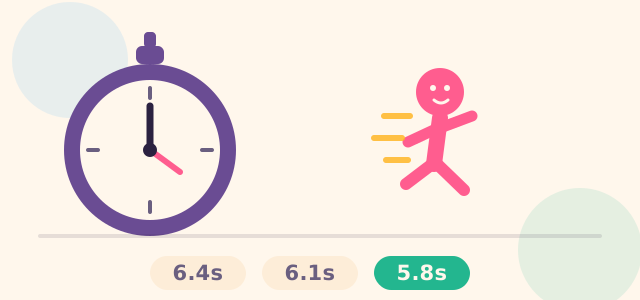
- Time each other. A stopwatch and a 20-metre stretch of lane or corridor. Run it, note the time, run it again next week. The improvement is the point.
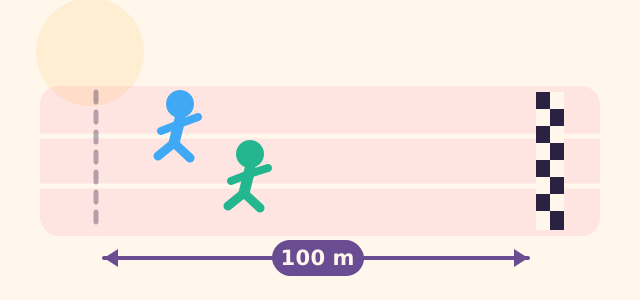
- Try the real distances. Mark 100 metres somewhere. Let them feel how far the sprinters go, then how far 400 metres is. It changes what they are watching.
- Hold a plank against the clock. Cheap, indoor, and progress shows within days.
- Make a home medal ceremony. Silly, and five and six-year-olds love it. Somebody has to hand out the medals and somebody has to come third.
- Find the map. When an unfamiliar country wins something, look it up. Over three weeks children pick up a surprising amount of geography this way.
The one that matters most is the stopwatch, because it makes your child’s own improvement visible. That is the transfer — from admiring a stranger to noticing they themselves got faster.
Keep it off their own sport
If your child already plays something, be careful. Watching a world final and then commenting on their Saturday match is a fast way to make the sport feel like an examination.
The people on the screen are the best in the world, and they mostly started because it was fun. Comparison at eight ends interest at eleven.
About the screen time
A Games is a legitimate exception to a normal weeknight rule, and it is fine to say so plainly: “This is on for two weeks, and then it is not.”
Two things worth holding on to. Watch the big ones with them rather than leaving it running in another room — the commentary is where most of the learning actually happens, from you, not from the broadcast. And protect bedtime. Many events fall in the middle of the night in Indian time; that is what the morning replay is for. A tired child takes nothing from anything.
If screen time is an ongoing argument in your house, the wider version of that conversation is in our screen time article.
Which Games, and when
The Commonwealth Games run every four years, and the Summer Olympics every four years too, staggered so a Games season comes around roughly every other year. The next Summer Olympics are in Los Angeles in 2028. India has also bid to host a future Commonwealth Games in Ahmedabad, which — if it happens — would be the first time most Indian children could watch a Games in their own time zone.
Check the current schedule before you plan anything around it; dates and host cities do change.
None of this needs a Games to be underway, though. A stopwatch, a marked distance and somebody to cheer for works in any ordinary week.