I Thought I Was Bad at Colours. I Was Colour Blind.
I found out I was colour blind in my engineering course. Until then I thought I was slow. What parents should watch for, and how to check gently.
As a child I could never keep colours straight. I would name a colour and be told it was a different one. I would learn the right answer, and the next time it was wrong again.
Nobody told me anything was different about my eyes. So I came to my own answer: I was bad at colours. I could not remember them. Everyone else had learned the names and I had not, so maybe I was a bit dumb.
I found out the truth during my engineering course. I am colour blind. My eyes see some colours differently from most people’s, and they always had. I had never been bad at remembering colours. I had been trying to remember differences that my eyes were not showing me.
I am writing this for parents, because I do not want a child to spend ten years thinking what I thought.
What colour blindness actually is
The name is misleading. Almost no colour blind person sees in black and white. Most of us see plenty of colour. We just mix up certain colours that look clearly different to other people.
The most common kind is called red-green colour blindness. Inside the eye there are cells that pick up red light and cells that pick up green. In a red-green colour blind eye, one of those two kinds works differently, so colours that depend on the red and green difference start to look alike.
That is why the picture below matters more than any definition. It is the same katori of chillies twice. The right one is how red-green colour blind eyes can see it:
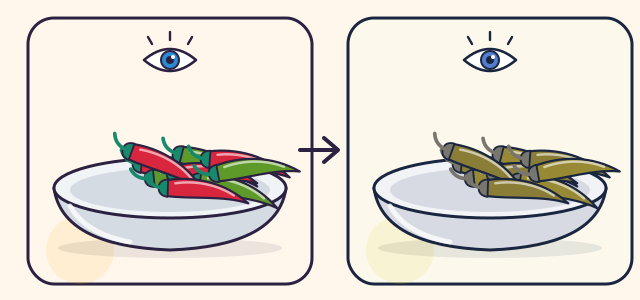
The right side was not drawn by guessing. Every colour in it went through the same scientific model that colour blindness simulators use. Many children have a milder version than this, so for them the gap between red and green is smaller but still there.
It is common, and it is not an illness
Red-green colour blindness is mostly passed down in families, through the mother’s side. The mother usually sees colours normally herself, which is why nobody in the family suspects it. The UK charity Colour Blind Awareness puts the odds at about 1 in 12 for boys and 1 in 200 for girls. The chance is higher for a boy whose mother’s father is colour blind. A girl can only be red-green colour blind if her father is too.
So in most classes there is probably at least one child with it. Very often, nobody knows, not even the child.
A few things I wish someone had told my parents:
- It is not a disease. It does not hurt, it does not spread, and the kind a child is born with does not get worse with age.
- It has nothing to do with intelligence. A colour blind child who keeps getting colours “wrong” is not slow and not careless.
- There is no cure, and there does not need to be. What helps is simply knowing, so the child and the people around them can work with it.
The colours that get mixed up
These are the pairs to watch. Top row as they are. Bottom row as red-green colour blind eyes can see them:
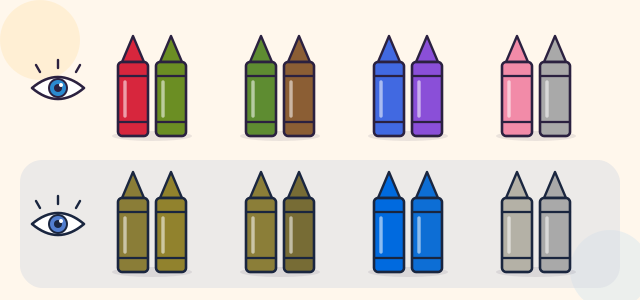
- Red and green, especially darker or dull shades
- Green and brown, the leaf and the tree trunk
- Blue and purple, because purple is blue with some red in it
- Pink and grey, or pink and white
Bright, strong colours are easier. Pale colours, dark colours, small things and dim light make it much harder. A child may get red right on a big red ball and wrong on a thin red line.
Signs a parent might notice
None of these alone means anything. Every young child mixes up colours while they are learning the names. What matters is a pattern that keeps coming back, with the same pairs, in a child who already knows the other colour names well:
- They know yellow, blue and white perfectly, but red, green and brown keep swapping
- Trees drawn with brown or purple leaves, or faces coloured green, again and again, when they are not doing it for fun
- They pick the wrong crayon, then say “they look the same”
- They find colour-coded worksheets hard: “circle the red ones”, “match the colours”
- Pale colours all look white or grey to them
- They struggle to see ripe red mangoes or tomatoes among green leaves
- They avoid colouring, or get upset about it, without a clear reason
The last one is the one I understand best. A child who keeps getting it wrong often decides they do not like colouring. It is easier than feeling stupid.
Children also hide it, usually without knowing they are hiding anything. They learn that fire engines are red and leaves are green, and answer from memory. Ask them straight out and they will say everything is fine. That is why it can go unnoticed for years, and why a calm game works better than a question.
The one idea that helps most: matching, not naming
When a parent asks “what colour is this?”, the child has to do two things: see the colour, and remember its name. If they get it wrong, you cannot tell which part failed.
So take the name out. Give them two things that are the same except for colour, and ask them to find the twin. A child who does not know the word “purple” yet can still match two purple crayons, if their eyes can see the difference. A child whose eyes cannot see it will mix up the same pairs every time, even with no names involved.
That is the idea behind our game Find the Colour Twins. The child plays a matching race with ludo tokens, bangles and crayons. You quietly notice which pairs, if any, keep getting mixed. It feels like a game to the child because it is one.
A game can spot a pattern. Only an eye doctor can check.
Please do not use any game, including ours, as a test. It can only tell you whether a check is worth booking.
A real colour vision check is done by an eye doctor or optometrist. It is quick and it does not hurt. For older children they use books of coloured dots with a number hidden inside. Children who cannot read numbers yet get versions with shapes, or a path to trace with a finger. Most children can be checked from about four or five years old. By five, a child with typical colour vision can pick out colour groups in a couple of seconds.
A normal eye check often does not include colour vision, even when the child gets glasses. Ask for a colour vision check by name.
If you want a first look at home
Printed plates are far more reliable than any screen. Printed copies of the dot picture book eye clinics use are sold in India, such as this 38-plate colour vision test book (₹249 on Amazon when we checked on 29 September 2026; an affiliate link, see our disclosure). A few things before you use one:
- It is made for readers. Most plates hide a number, so it suits children who read numbers well, usually from about six.
- Light matters. Use daylight near a window, not strong sun and not a tube light.
- Copies vary. Some buyers say the colours in cheaper prints are faint. A plate your child misses at home is a reason to book the eye check, never the answer.
- Keep it a game. Call them hidden pictures, and never mark an answer wrong in front of the child.
Tests on a phone or laptop screen are not reliable, because every screen shows colours a little differently. Our Play corner has a dot picture game in this style, Hidden in the dots. Children enjoy it, and it is a game, nothing more.
When you book it, say it plainly and calmly: “The eye doctor has a fun picture book. Let’s see what you spot.” No need to say “test”. No need to say “problem”.
If your child is colour blind
How you say it matters more than anything else in this article. I would say something like: “Your eyes see some colours in their own way. Lots of people’s do.” In our house I can add: “Papa’s eyes do too.” Then carry on with the day.
After that, small things make school and home easier:
- Tell the class teacher. Many teachers use red chalk on a green board for corrections and underlines. For a red-green colour blind child that red can nearly disappear:
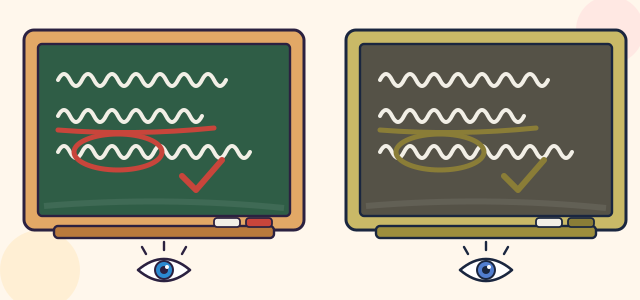
White or yellow chalk fixes it. So does a teacher who says the colour out loud when giving an instruction.
- Label the crayons and pencils. Write the colour name on each one, or keep them in a fixed order in the box. The child then colours by the name, not by guessing.
- Tell the sports coach too. Team bibs, and coloured lines on a playground or hall floor, can be hard to tell apart.
- Teach other clues. Traffic lights have a fixed order: red on top. Ripe fruit feels softer and smells sweeter. Some colour blind children refuse a food because it looks wrong to them, like greens that look brown. That is their eyes, not fussiness.
- Let the family see through their eyes. Free colour blind simulator apps turn a phone camera into their view. Cousins stop teasing once they have seen it.
- Never make a game out of catching them out. “What colour is this then?” in front of cousins is not funny for the child.
- Think ahead, not with fear. A few careers in India check colour vision, such as pilots and some defence and railway jobs. Most careers do not. Knowing early simply means no surprise at 18. I studied engineering and work in it today.
What I want parents to take away
I lost years believing I was slow, when all I needed was one sentence from an adult: your eyes see colour differently, and that is fine.
If your child keeps mixing up the same colours, do not push harder on the names. Play the matching game, watch calmly, and if the same pairs keep getting mixed, book an eye check. Either way, your child learns the thing I did not: that getting a colour wrong never meant they were not clever.
For more, including advice sheets by age, see Colour Blind Awareness’s page for families.