What you need
- Pairs of things that are the same except for colour: ludo tokens, bangles, crayons, bottle caps or clothes pegs
- At least one pair each of red, green, brown, blue, purple, pink and grey, plus easy ones like yellow and white
- A cloth bag or dupatta to hide them in
- A steel thali to line up the twins
- Good natural daylight near a window, not strong sunlight or a tube light
How to play
- 1
Make the twin pile
Put one of each pair in the bag. Line up the other one of each pair on the floor, spread apart. If the crayons have names printed on them, turn the names face down so the game is about seeing, not reading.
- 2
Pull one out, find its twin
Your child pulls one thing out of the bag without looking, then runs to find its twin on the floor. Twins stand together on the thali. Do not ask for colour names. Just 'find the twin!'
- 3
Race the clock, or race you
Count out loud while they find each twin, or take turns and race each other. Let them win often. Put the easy colours in so there are plenty of quick wins.
- 4
Never say wrong
If a red token ends up with a green one, do not correct it. Say 'twins!' and keep playing. Just remember which pair it was.
- 5
Swap roles
Now you pull from the bag and your child checks your twins. Put one mismatched pair on the thali on purpose, like red with green. See if they catch it.
- 6
Note it later, play again another day
After the game, not during it, jot down any pairs that got mixed. Play two or three more times over a week or two. One mix-up means nothing. The same pairs mixed every time, while other colours are easy, is worth an eye check.
What your child is learning
Honestly stated — this is what the activity actually builds, not a list of everything it might touch.
- Matching by one property, the base of sorting and early maths
- Looking closely and comparing two things side by side
- Quick decisions and a bit of healthy racing
- Checking someone else's work, and catching a mistake
This is a matching game, and for your child that is all it is. For you, it does one more quiet job: it shows which colours your child’s eyes can tell apart, with no pressure and no names involved.
Why matching, not naming
“What colour is this?” asks a child to do two things at once: see the colour, and remember its word. A wrong answer does not tell you which one slipped. Most three-year-olds are still sorting out the words, and that is normal.
Matching takes the word away. A child who does not know “purple” yet can still put two purple crayons together, if their eyes see the difference. So when the same pair keeps getting mixed, with no words in the way, that tells you something real.
The pairs to include
Red-green colour blindness, the most common kind, mixes up these pairs. Top row as they are, bottom row as colour blind eyes can see them:
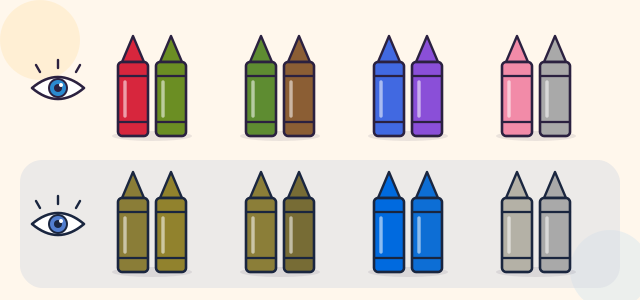
A ludo set gives you red, green, blue and yellow. Add brown, purple, pink and grey from the crayon box or the bangle stand. Dull and dark shades show a difference more than bright ones, so do not pick only the brightest.
What to watch for
- A pattern, not a slip. The same pairs mixed across three or more games, while yellow, blue and white are always right.
- “They look the same.” If your child says this about red and green, believe them.
- Slowing down on some pairs only. Quick on most twins, then long hesitation over green and brown.
If you see the pattern, book an eye check with an eye doctor or optometrist. It is quick, painless and done with picture books of dots, which most children enjoy. Say “let’s see what you spot in the eye doctor’s picture book”, not “test”.
What this game cannot do
It cannot diagnose anything. Tiredness, a dim room, a child who is bored, or a child who thinks mixing twins is funny will all cause mix-ups. The game only tells you whether an eye check is worth booking. The check is what gives an answer.
And if your child does turn out to be colour blind, it is not an illness and has nothing to do with how clever they are. Our article I Thought I Was Bad at Colours. I Was Colour Blind. explains what helps at home and school.
Grow it with the child
- 3 years: four easy pairs and two tricky ones. Let them win.
- 4 to 5 years: all the pairs, plus a count to see how fast they are.
- 6 to 8 years: hide the floor twins around the room. Or play in pairs with a sibling, each checking the other’s thali.
Published 28 September 2026 · Suitable for Toddler, Preschooler, Early schooler, Big kid