Unlocking Your Child's Potential: The Real Role of Parents in Early Learning
Everyday moments, like sorting laundry, cooking dinner or walking to the shop, are where most early learning actually happens. Here is how to use them.
In the tapestry of childhood, every giggle, every question and every shared adventure is a thread. As parents we tend to assume the important learning happens elsewhere — at school, in a class, from an app. It mostly does not. It happens in the ordinary hours you already spend together.
This is not a call to fill those hours with lessons. It is the opposite. It is about noticing how much learning is already available in a normal Tuesday, and doing a few small things differently.
Why play does the heavy lifting
Children do not learn in the way adults imagine learning works — sit down, receive information, remember it. They learn by handling things, testing them, getting it wrong and trying again. That process has a name, and the name is play.
Through play a child tests ideas, builds vocabulary, practises being frustrated without giving up, and finds out what their body can do. Cognitive, physical and emotional growth all run on the same track.
Three habits that change everyday moments
Be present, briefly. Ten fully attentive minutes beat two distracted hours. Put the phone in another room, sit at their level and follow whatever they are already interested in. Children can tell the difference, and they open up for the version of you that is actually there.
Turn tasks into talk. Counting potatoes while cooking. Naming colours while folding clothes. Wondering out loud why the pressure cooker whistles. None of this needs preparation — it needs you to say what you are already doing.
Welcome the questions. When a four-year-old asks why the sky is blue, the answer matters less than the response. “That is a good question, let us find out” teaches something an instant answer never does: that not knowing is the start of something, not an embarrassment.
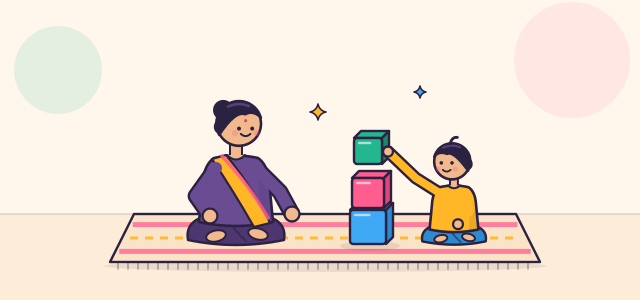
What good “educational play” looks like
- Stories and reading. Read together, or tell stories from your own childhood. Both build language. Do it in whichever language you speak most comfortably at home.
- Making things. Paper, colours, dough, boxes. Creative play builds fine motor control and, more importantly, the confidence to have your own ideas.
- Going outside. A walk in the park teaches biology, physics and geography without any of those words being used.
- Problem games. Puzzles, board games, card games. Patience, strategy and losing gracefully are all learnable, and games are where they are learnt.
Where screens fit
Technology is part of childhood now, and pretending otherwise helps nobody. Used deliberately, it is useful; used as a default, it crowds out the things that build more.
Three things make the difference: choose apps and videos made by people who understand child development; keep total screen time bounded so it does not replace physical play and face-to-face talk; and watch alongside your child when you can, asking about what you are both seeing. A child who can talk about what they watched is in a different relationship with a screen than one who just absorbs it.
The point is not to teach every minute
You do not need to convert bedtime into a curriculum. The goal is an environment where curiosity is welcome, questions get taken seriously, and learning through play is simply how the house works.
These years pass quickly. The good news is that the most valuable thing you can give a child during them — your attention, in ordinary moments — costs nothing and is already within reach.
Common questions
How much screen time is appropriate? The American Academy of Pediatrics advises avoiding screen media for children under 18 months, except video calls. From 18 to 24 months, watch together so you can explain what is happening. From 2 to 5 years, about an hour a day of high-quality programming, watched with you where possible.
Can play really improve school results? Yes. Play builds vocabulary, attention span, problem solving and social skills — the exact foundations that later academic work is built on.
I work full time. Where is the time for this? In what you are already doing. Talk about shapes while shopping. Count steps on the stairs. Tell one story at bedtime. Quality and consistency matter far more than quantity.