The Story of Dussehra: What to Tell Your Child
What Vijayadashami means, the stories of Durga and of Rama told gently, why Ravana has ten heads, how India celebrates, and a game to play at home. Explained simply, with pictures to show your child.
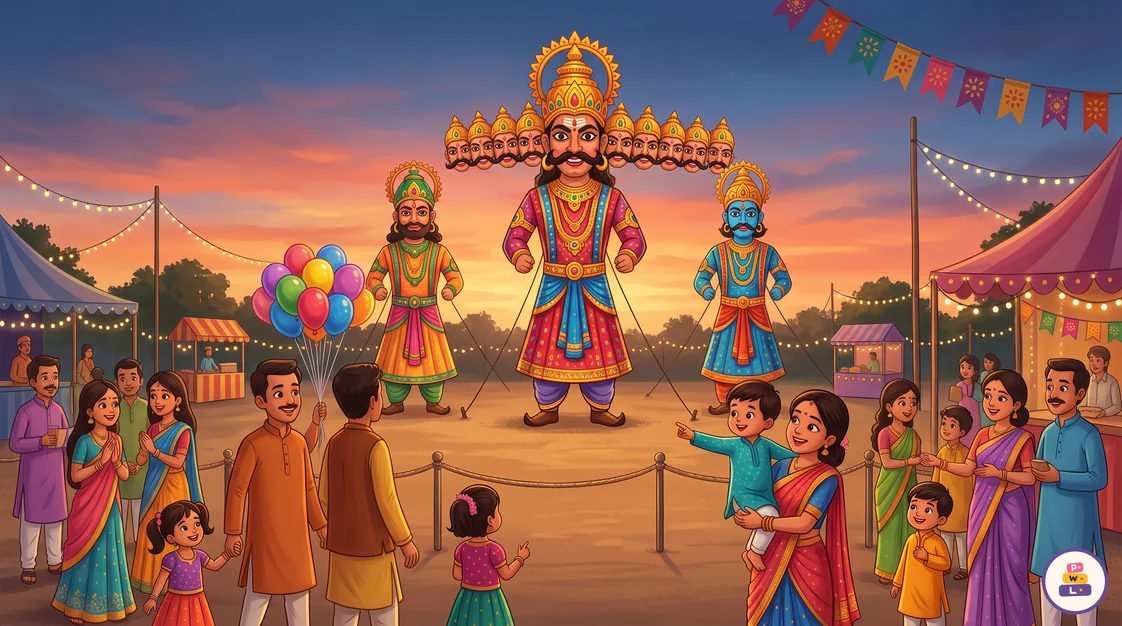
After the nine nights of Navratri comes the tenth day: Dussehra, also called Vijayadashami. In 2026 it falls on 20 October. Children see the tall figures of Ravana in the maidan, the last night of the Ramlila, the last day of the pandals, and sooner or later one of them asks what it is all about.
Here are the answers, one picture at a time. Read a section, show the picture, and let your child ask the next question.
What does Dussehra mean?
Vijayadashami is two words: vijaya, victory, and dashami, the tenth day. It is the day of victory that comes after the nine nights.
Dussehra is usually explained as dasha, ten, and hara, taken away: the day the ten-headed king Ravana was defeated.
Two different stories end on this day. Which one your child hears first depends on where you live, and many families tell both.
The first story: Durga wins
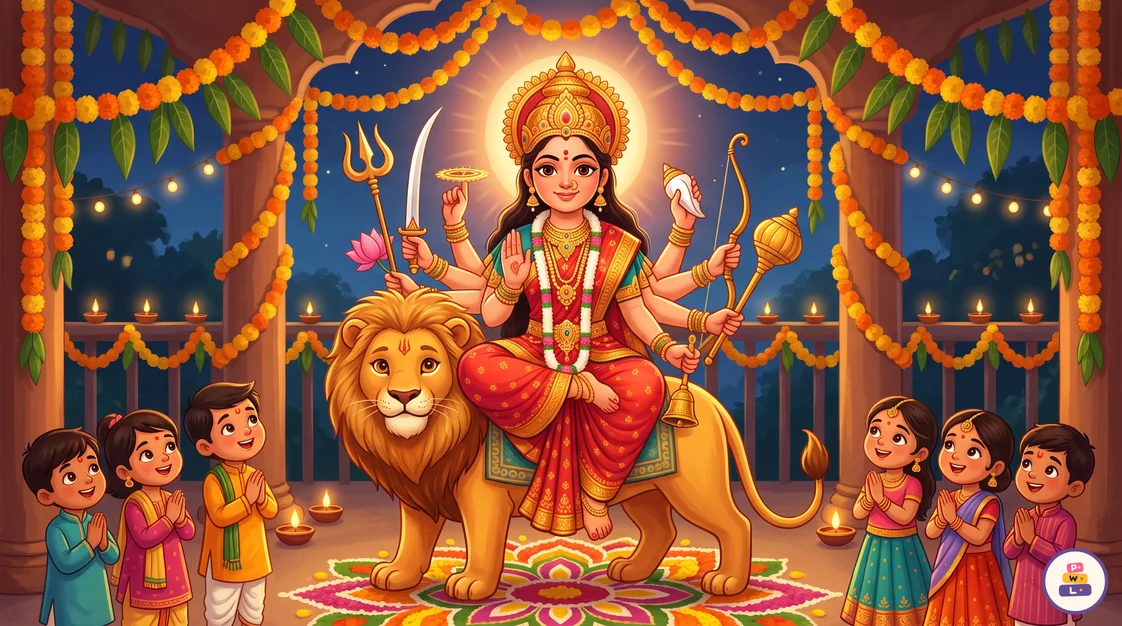
In Bengal and the east, Vijayadashami is the last day of Durga Puja.
The story goes that a buffalo demon called Mahishasura grew so strong that no god could stop him. So the gods joined their light together, and out of that light came the goddess Durga. Each god gave her a gift to hold, which is why pictures show her with many arms, often ten. She rode out on her lion, faced Mahishasura for nine days and nine nights, and on the tenth day she won.
Ask: Durga rides a brave lion. Which animal would you choose as your brave helper?
The second story: Rama comes to rescue Sita
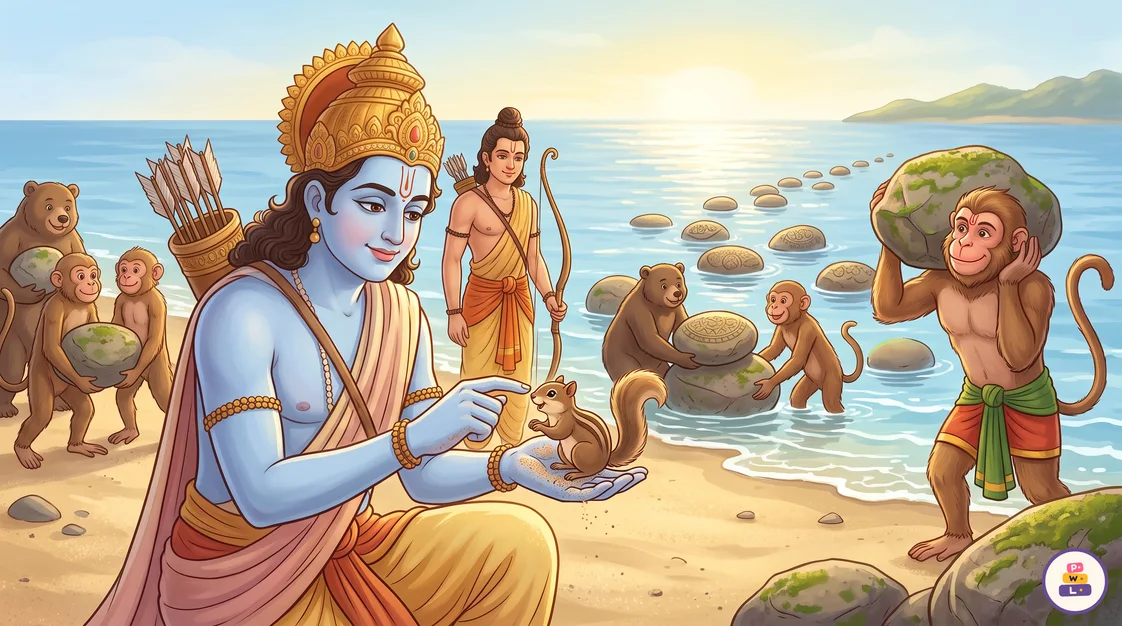
In the north, Dussehra belongs to the Ramayana.
Long ago, Prince Rama went to live in the forest with his wife Sita and his brother Lakshmana. One day Ravana, the king of Lanka, came in disguise and carried Sita away to his island across the sea.
Rama searched everywhere. Hanuman, who could leap across the sea, found Sita in Lanka. Then an army of monkeys and bears carried stones to the shore and built a bridge across the water. Many grandmothers add a small squirrel, who rolled in the sand and shook it onto the bridge to help. Rama stroked its back, and the stripes on a squirrel’s back, they say, are where his fingers touched it.
Rama crossed the bridge, Ravana was defeated, and Sita was free. That victory is what Dussehra remembers. Many families also say that the lamps lit to welcome Rama, Sita and Lakshmana home to Ayodhya are the lamps of Diwali, a few weeks later.
Ask: the squirrel could only carry a little sand. Did its help count?
Why does Ravana have ten heads?
In pictures and on the big figures, Ravana has ten heads, and families explain them in more than one way.
Many say the ten heads are ten bad habits that everyone has sometimes, such as anger, greed, jealousy and pride, and that Dussehra is a day to let go of our own. Others say the heads show how learned Ravana was. That makes the story sharper for an older child: being clever is not the same as being kind.
In many towns of the north, huge figures of Ravana made of bamboo and paper are burnt at sunset, often with his brother Kumbhakarna and his son Meghnad beside him.
The figures are packed with crackers. Watch from well back, keep your child’s hand in yours, and cover small ears for the bangs.
Ask: which of those habits do grown-ups find hardest to let go of? Then tell them yours first.
How India celebrates Dussehra
- North India: the last night of the Ramlila, and Ravana figures burnt at sunset.
- Bengal and the east: Bijoya Dashami, the last day of Durga Puja. Durga’s idols are taken to the river, and families visit each other with sweets.
- Mysuru, Karnataka: the Dasara procession, with decorated elephants through the city.
- Kerala and the south: Vidyarambham, when small children write their first letters in a plate of rice. Ayudha Puja, on the day before, honours tools, books and vehicles.
- Maharashtra: apta leaves are shared with elders as “gold”.
- Gujarat: fafda and jalebi on Dussehra morning, after nine nights of garba.
- Kullu, Himachal Pradesh: a fair that starts on Dussehra and lasts a week.
What can Dussehra teach a child?
Three things, and you do not need to lecture any of them. Tell the stories, and notice them out loud.
- Courage: Durga faced what nobody else could. Rama crossed the sea.
- Every bit of help counts: Durga was made from everyone’s light. Rama’s bridge was built by monkeys, bears and one small squirrel.
- A fresh start: letting go of a habit, the way Ravana’s figure goes up in smoke.
Ask at the end of the day: which story did you like better, the goddess on the lion or the prince with the bow?
Try this at home
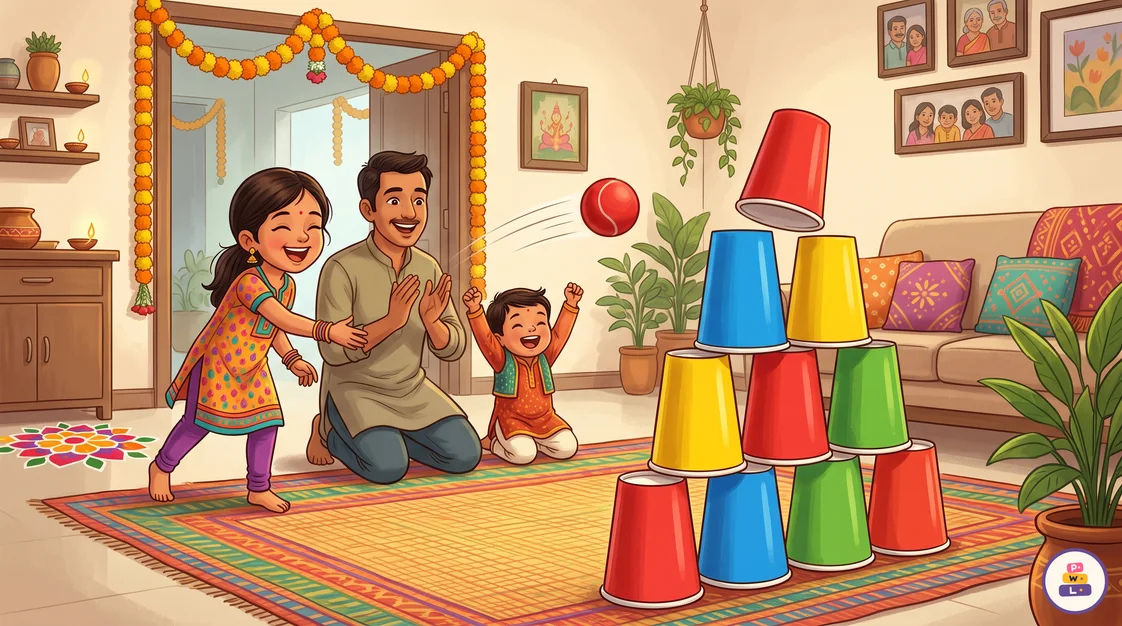
- Ten cups, ten habits. Stack 10 paper cups in rows of 4, 3, 2 and 1. Take turns naming a habit for each cup that anyone in the family has sometimes: anger, shouting, grabbing, not sharing. Grown-ups go first. Then knock them down with a soft ball. Afterwards ask: what is one good habit you want to grow? Rebuilding the pyramid is counting practice too: 4, 3, 2 and 1 make 10.
- A courage crown. Cut a crown from yellow chart paper and let your child decorate it with bindis, foil and crayons, to wear while you tell the story.
- First letters in rice. Spread rice on a plate and let your child trace shapes and letters with a finger. Our phonics guide explains which letters to start with.
If your family danced garba these nine nights, read the story of garba together too.
A note on the stories
These are the versions many families tell, kept gentle for small children. Every region, and every grandmother, tells them a little differently. If your family tells a story another way, tell it your way: the version your child hears from you is the one they will remember.
The pictures on this page were made with Google Gemini and checked by us before publishing.