From Garbhsanskar to Playtime: Where Learn with Play Came From
How studying an ancient practice during pregnancy turned into a website about rice trays and stacking katoris, and what carried over.
Learn with Play did not begin with a website. It began during my pregnancy, when I started reading about Garbhsanskar — the traditional Indian practice of nurturing a child before birth through calm surroundings, music, reading and the mother’s own state of mind.
What struck me was not whether every claim held up. It was the underlying assumption: that a child’s development is not something that starts on the first day of school. It starts far earlier, and it is shaped by the ordinary environment a family creates.
Then Jaineel arrived
Theory meets reality quickly with a newborn. What I found was that the ideas that survived contact with real parenting were the simple ones:
- A calm adult matters more than an enriching toy.
- Repetition is not boring for a baby — it is the method.
- The child is paying attention to you constantly, especially when you think they are not.
Everything else — the schedules, the flashcards, the guilt about not doing enough — fell away within a few months.
Why “play” ended up in the name
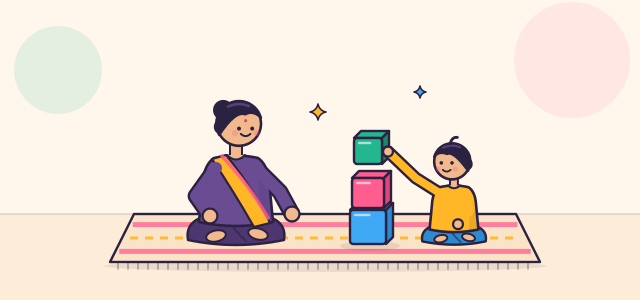
Once I started looking, I saw that almost every genuinely useful thing I did with my son looked like play from the outside. Stacking katoris. Hiding spoons in rice. Narrating what I was cooking.
None of it looked like education. All of it was.
That is the whole idea behind this site: the highest-value things a parent can do are usually free, usually short, and usually already within reach in the kitchen. What is missing is not money or equipment. It is somebody saying this counts — and giving you a specific thing to try today.
What we do here
Every activity on this site is meant to pass three tests:
- Can you do it today, with things you already own?
- Is the developmental reason honest — do we actually say what it builds, without exaggeration?
- Does it work in a real Indian home — small flat, joint family, limited time?
We publish in English, Hindi, Marathi and Gujarati because the play should happen in the language your family actually speaks. That is not a nice touch; it is the single biggest thing that decides how much your child gets out of it.
Ancient and modern, without pretending
I do not claim Garbhsanskar as science, and I do not dismiss it. It gave me a frame I still use: pay attention to the environment you build around a child, because they absorb it long before they can talk about it.
The rest — the stacking, the sorting, the mess — is just what that looks like on a Tuesday evening.
Thank you for being here. If something on this site gives you one good twenty minutes with your child, it has done its job.